Dean Atta is an award-winning British poet renowned for his work that is a unique celebration of heritage and the LGBTQ+ community. His innovative and hopeful exploration of queer narratives led him to be listed as one of the most influential LGBT people in the UK in the IoS Pink List 2012.
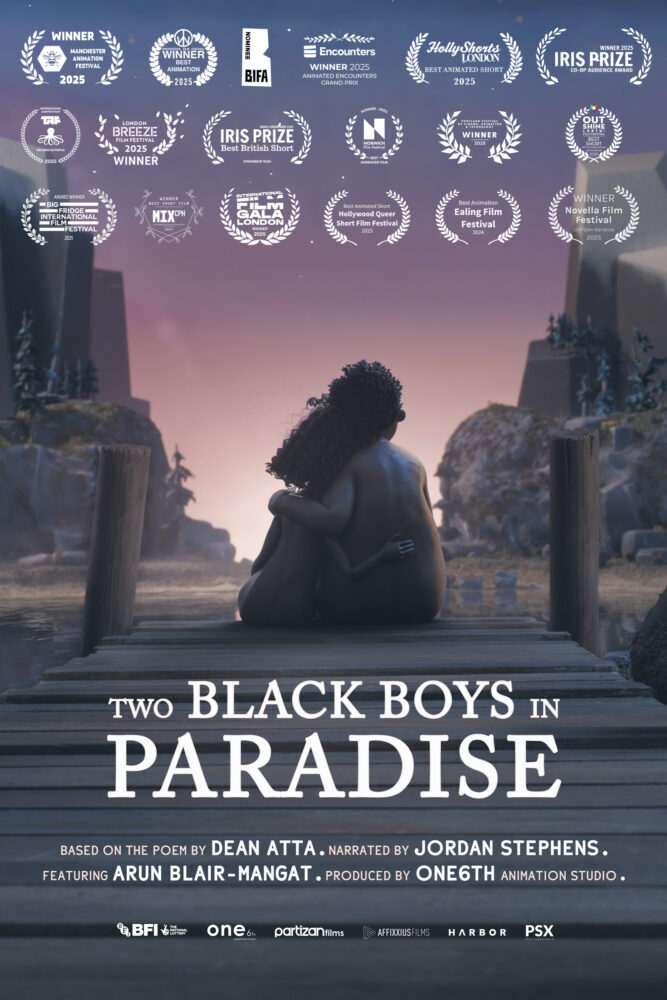
From writing various novels across a wide range of genres, to recently wining the BAFTA for his short film Two Black Boys in Paradise, Atta has had a vibrant and successful writing career.
But how did he reach this level of success? In this interview, Atta takes us along for an emotional and inspirational journey. He shares all the wisdom he has learned along the way, from loving yourself, finding your authentic voice, and everything in-between.
You are an incredibly talented writer and have written so many poems over the years. So, I wanted to know, what does the word ‘poetry’ mean to you and how would you personally define it?
Poetry, to me, is a way of expressing yourself that cuts through the literal and speaks to the heart. Sometimes a poem can be fantastical but feel true even though it’s not necessarily factual. It is about helping people to experience something they may have never experienced or to articulate feelings for the people that can’t.
For me, when I first started writing poetry in my teens, it was a way for me to express the things that I wasn’t ready to have conversations about. I was writing about things like being mixed race, being between cultures, and knowing I was gay but not being ready to come out. This really helped me to figure out who I was, my place in the world and where I belonged.
When was it that you first started writing and was there a specific moment that you fell in love with it and knew it was for you?
I wrote for myself at first, and it was almost like my diary, so I always kept those poems private. Eventually, I started to show a few friends and by the age of sixteen I’d shown enough to know that my writing was something that people could relate to.
They encouraged me to share it, and someone told me about an open mic where you could go and read your poetry to strangers. I went to give that a go and it was really fun because there was no pressure. If people didn’t like it or I felt uncomfortable, I could go away and never see them again.
But they did enjoy it and gave me a round of applause and I thought, “This is great!” My only concern back then was that I was dyslexic, so I found it hard to read my writing aloud. That’s why I decided to start memorising it and doing spoken word and performance poetry. This meant that I could be bigger and more dramatic in how I presented my poems, and I remember feeling like I was in a Shakespeare play.
I knew it was for me when I was performing my poetry and people responded to it well. I remember one poem called Fatherless Nation, which was about my dad not being around when I was growing up. When I performed that, people of all ages came up to me to say how moved they were. This was from people much older than me, as well as my age, so it felt like what I was saying had a universal truth that could connect with all ages.
Since you started your creative journey, you have written a lot of work that is hopeful and celebratory about the LGBTQ+ community. Why do you believe it is so important to have this hopeful narrative and how do you balance that with showing the struggles?
I think we are already aware of the struggles, we have documented them through news articles and fiction. I feel as though many LGBTQ+ individuals can speak for themselves and share their truth and reality online. But as a creative person, I feel like it is my duty to provide hope because we are all already aware of the difficult struggles that people are going through.
I want to provide that counter narrative that says, “There is hope and you can find a way through this.” I think that my poem Two Black Boys in Paradise is one that really connected to lots of people because even though it centres two queer black boys, it also speaks to people of different races and gender expressions who could see themselves in that paradise place we have created.
The fact that we have turned this into a film that has won a BAFTA means that the artistry is being recognised as well as the message. I feel like as a creative, that is the ultimate goal; to have written something with meaning that is done with some kind of skill or creativity that people recognise.
I feel like people need to see more media that celebrates LGBTQ+ existence, because if people aren’t already in that accepting place completely it can give them hope and something to strive towards.
When you worked on your recent short film Two Black Boys in Paradise how did it feel to see your writing coming to life? Did you have any nerves about it?
It was beautiful to have my poem turned into a film because I knew that it could reach more people. As a dyslexic person, I do read but when I was younger this was something I struggled with, and I know lots of people struggle with this for various reasons. So, I feel as though my poem existing in a book is only ever going to have a limited audience. Once you put a poem on screen and it is available to watch on Channel 4, it means so many more people can find it, enjoy it, and share it.
I really loved all the skill and artistry that went into the making of the film. Since animation isn’t a skill I personally have, I was really honoured that people would want to spend time to turn my poem into an animation. It took five years and a team of over 100 people to make our nine-minute animation, so I was just blown away by the dedication involved.
I’m grateful to Baz Sales, our director, and Ben Jackson, our producer, for leading that team for so long to get us to the point of winning a BAFTA! This is just so huge and not something I ever dreamed of.
With my poetry, all I ever wanted was to reach some people, whether that is by performing them at an open mic night or people finding them in a book or online. So, I think this film is a great way to reach a bigger audience with a message that matters so much to me.
Throughout this process of working on your film and your writing journey as a whole, in what ways do you feel that you and your writing have evolved? What are the biggest lessons you have learned along the way?
I think that being specific is important, because if you can tell a specific and authentic story, people find ways to connect to it, and it feels universal to them. This is because you’ve created characters that feel real, and so people really relate to that. I try not to be generic and be really specific so that everything feels real and put a lot of myself into every character I create, along with my friends and loved ones too.
I think drawing from real life means that it feels real to the people who receive it. What I’ve loved is being able to hear from my readers and audience. I got to travel around to film festivals with Two Black Boys in Paradise and see the reactions of audiences at festivals all around the world. When I write for young adults, I get to go into schools to give assemblies and workshops and hear what students think of my work.
This for me informs what piece I’m going to create next because I can hear what matters to them, what moves them, and what they resonate with. That really helps me to think, “Okay, where do I want to take my writing next?”
So, I think it is just staying connected to audiences, in person more than online. Comments and online reviews are all well and good, but when you’re looking someone in the eyes and they’re telling you how your work has moved them, that’s so special. So, I am really lucky to get to travel around and meet people that have engaged with my work.
Much of your writing is targeted towards younger audiences. What would you say to a young writer or perhaps someone who was struggling with accepting their identity?
I would say to write it out and figure it out on the page. I found that was helpful for me because my identity shifts. Even as an adult, I feel that I am still evolving, changing, and finding different ways to describe who I am.
But at my core, I am the same person, it is just that the world has changed and the words to describe ourselves change over time. That’s interesting, because sometimes you won’t have the right words, but often it is about finding the right people; the ones who accept you for who you are and recognise that that is always changing and that’s okay. You can be fluid in your identity; you don’t have to reach a final destination with it.
you need to find that true version of you and protect it. That doesn’t mean exposing it to everyone, it means finding the people around you that respect and love you as you are.
- Dean Atta
If you could speak to that younger version of yourself, what is something that you would say?
I think my younger self was very open. Even though I came out at the age of fifteen, I’d say that being out isn't the end goal. You are still always coming out to new people that you meet. It’s not that you come out once and that’s it. You must decide in any given situation who you want to be out to.
Do you feel safe? Do you trust these people? Are they worth sharing your true self with because sometimes you can’t be bothered and that’s okay, not everyone needs 100 percent of you. But you need to find that true version of you and protect it. That doesn’t mean exposing it to everyone, it means finding the people around you that respect and love you as you are. But it starts with yourself, you have to respect and love yourself first and foremost.
Looking forward now, a lot of things are starting to change in the world and AI is becoming a big topic of discussion. I was wondering why you believe authentic writing is so important, especially now?
I’m one of the many authors whose work has been scraped from the internet to train AI. I went with The Society of Authors on a protest to Meta to deliver a letter where we told them our concerns. But they locked the doors and wouldn’t let us in, which shows that these tech companies just don’t want to engage in this conversation.
Hopefully we are putting pressure on the government to do more and regulate this but sometimes it feels like the horse has bolted already and this is too far gone. Personally, I sometimes feel quite helpless. But I do feel happy to be part of an organisation like The Society of Authors, because I know they are fighting on behalf of all writers. I think it is really important to have a bigger organisation fighting for you, and that’s why I think unions in general are so important.
In terms of real human creativity, I hope that we will find a way to stay connected. I have started going to the theatre more because I love seeing performances by people who I know are real because you get so much AI slop.
I’ve recently come into the film industry with my short film, and already I am seeing film makers I respect using AI and I’m really sad about that. I’m still happy to sit around a campfire and tell my poems to people or go back to spoken word events so that people know that I am a real person whose words are real.
There are still people out there that want human created artworks, but there are people who don’t care and just want fluff that entertains them. But they aren’t my target audience, I want people to care and engage with the art. I think it matters who made something, whether that's a painting or a song. I like to know who has made something and their story rather than just the result.
Everything that I create I feel is an extension of me in some way. So yes, you could ask AI to write something in the style of Dean Atta, but it would never be original, it would just be taking what I have already written and mashing it together somehow. Every year I live I have more experiences and am trying to do something new and challenge myself as a writer. I think that is what a lot of artists are doing, trying to speak to our time and create something original because AI cannot be original by design.
With this originality that you speak about, how do you feel like you have been able to develop that? How did you find your writing voice and make it something that is uniquely yours?
My writing voice comes from my relationships with people; I pick up phrases from my friends and family. But it is also everything I’ve read, the music I’ve listened to and the physical experience of being in the world. It’s being loved, spending time with my nieces, going to the park, and being with my boyfriend and our lives coming together.
Travelling also expands my horizons. When I go abroad, I pick up on things from different cultures and notice my life differently when I see it in contrast to somewhere else. I think travel is an amazing thing because it can give you different references as a creative person since you see the world in a different light.
I’m already a mix of different cultures, but I love going and meeting people from different cultures and seeing how we all live on this Earth together. So, for me it's this curiosity, I do a lot of research and speak to family and friends so that I can see this fresh perspective.
I like to be very visceral in my writing. I think about what people are eating and the sights, sounds, and smells of the world that I’m creating. I want people to be transported when they read my work and feel the feelings, the smells and the taste of the world.
I try to have an embodied experience, which is the opposite of AI. It doesn’t have a body, it can’t live in the world like we can, and so that’s what makes humans special because we can.
Out of all these places that you have visited, is there one that has inspired you the most? Or are there any key individuals or writers in your life that you get your inspiration from?
Many writers have inspired me. Benjamin Zephaniah was a huge inspiration and mentor to me and he sadly passed away. I found him at an event and put some of my poems on a CD for him to listen to, and he encouraged me to keep going and to publish my first book. He came to my gigs to support me, and I would write to him and ask for his advice, so this was a really special relationship.
In terms of places, I spent three years living in Glasgow which was a special time as I saw a completely new way of life. Life in London can be so hectic and busy, and Glasgow is slower paced and friendlier.
Being able to go out to the Scottish Highlands and all around Scotland was a special experience for me that comes up in many books I have written. For example, Scotland features heavily in Only on the Weekends and Person Unlimited.
What I took from that time is that another life is possible, one where you travel and spend long amounts of time in nature. As a writer, it made me realise that you don’t need to be in the thick of it to be creative and that sometimes removing yourself from the hustle and bustle is the best thing you can do.
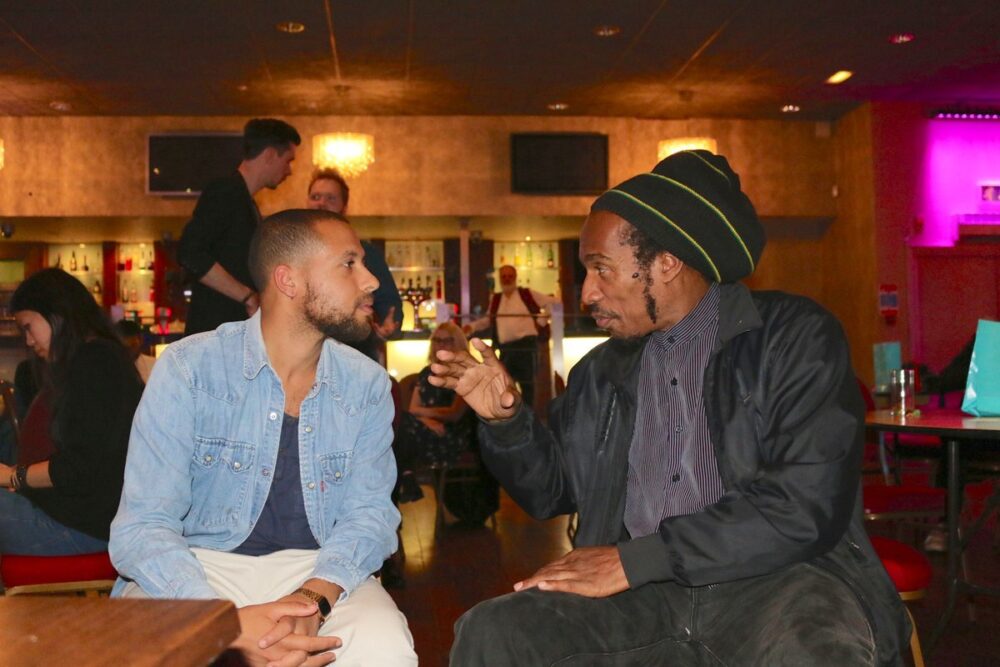
Many writers have inspired me. Benjamin Zephaniah was a huge inspiration and mentor to me
- Dean Atta
Writing clearly means so much to you, which is lovely to see, but I was wondering if any aspects of it have been challenging? How have you overcome these challenges and what makes it worth it to push through the difficulties?
I think success is its own challenge, because when your books have been successful there’s a pressure to recreate that success. This isn’t something that can always be recreated, sometimes it’s magic and sometimes it's not. It is all about chance, circumstance, coincidence and even just luck, you know? It is not a formula.
Having a small amount of success might make you want to chase it, but I’ve decided to chase feeling creatively fulfilled instead. For me, this looks like changing genres and what age groups I write for. I’ve written poetry, prose, fiction, non-fiction, and have now co-written a film. Constantly changing genres and forms helps me to feel this fulfilment but also to reach new audiences.
It is interesting jumping around from genre to genre because that isn’t the typical path of a writer and I have never tried to be typical. I try to be myself; someone who has varied interests and is interested in people of all ages. From a marketing perspective this is a challenge but for me it is a pleasure to write in all these different mediums and I love it.
Do you have a favourite project or book that means the most to you?
My favourite is the one that is coming next. For example, I’ve just had a picture book come out called Auntie’s Bangles, and I love that because it is a special book all about helping children deal with grief through remembering the person that has died and celebrating their life.
I’ve already had messages from people who have used it as a tool to help explain the passing of a loved one to their child. This is so special to me to be able to create something that can be healing for people.
The next book I have coming out in September is my first adult novel called Big Man. This is completely different because it is about the things I’ve wanted to write about for a long time, but because I’ve been writing children’s books, I’ve held myself back from it. But now it's time to put it all out there, and Big Man looks in depth about issues such as sexual assault, mental health and exploring masculinity.
I’m excited because I get to write about the topics that matter to me and it is a pleasure to have the opportunity to keep writing and publishing work that matters to me.
Where do you see yourself in five years' time and how do you see your writing progressing?
I had so much fun working on the film adaptation of my poem Two Black Boys in Paradise and turning more of my books into films is something I’m keen to do. Hopefully, in five years' time some of these will have been released, either on TV or in the cinema.
That is the hope of adapting my work for the screen and stage, reaching wider audiences with these messages of love and acceptance and celebrating queer people, black people, and anyone who feels marginalised in this world. I want to make sure that our stories are told and that we feel seen and celebrated.
Dean Atta’s story is heart-warming and inspirational, and his perspective is truly one-of- a-kind. At the heart of his journey and writing, we can all learn the importance of self- love and acceptance. Atta has taught that at the core of all great art is authenticity and truth. What makes his writing so special is his ability to have a unique voice, speak his truth, and share messages that matter. Atta’s stories will continue to impact people and change lives for years to come.
Watch Dean Atta's BAFTA award-winning short film Two Black Boys in Paradise here.
Sarah Curless was an Arts Emergency mentee in 2023 and is currently studying Journalism and university.